
AGI is not the goal — DeepMind’s path to superintelligence (ASI)
Google DeepMind’s report “From AGI to ASI” maps the road beyond human-level general AI (AGI) to superintelligence (ASI): four routes, the frictions that impede them, and preparation at the scale of humanity. Here is the throughline executives should take from it.

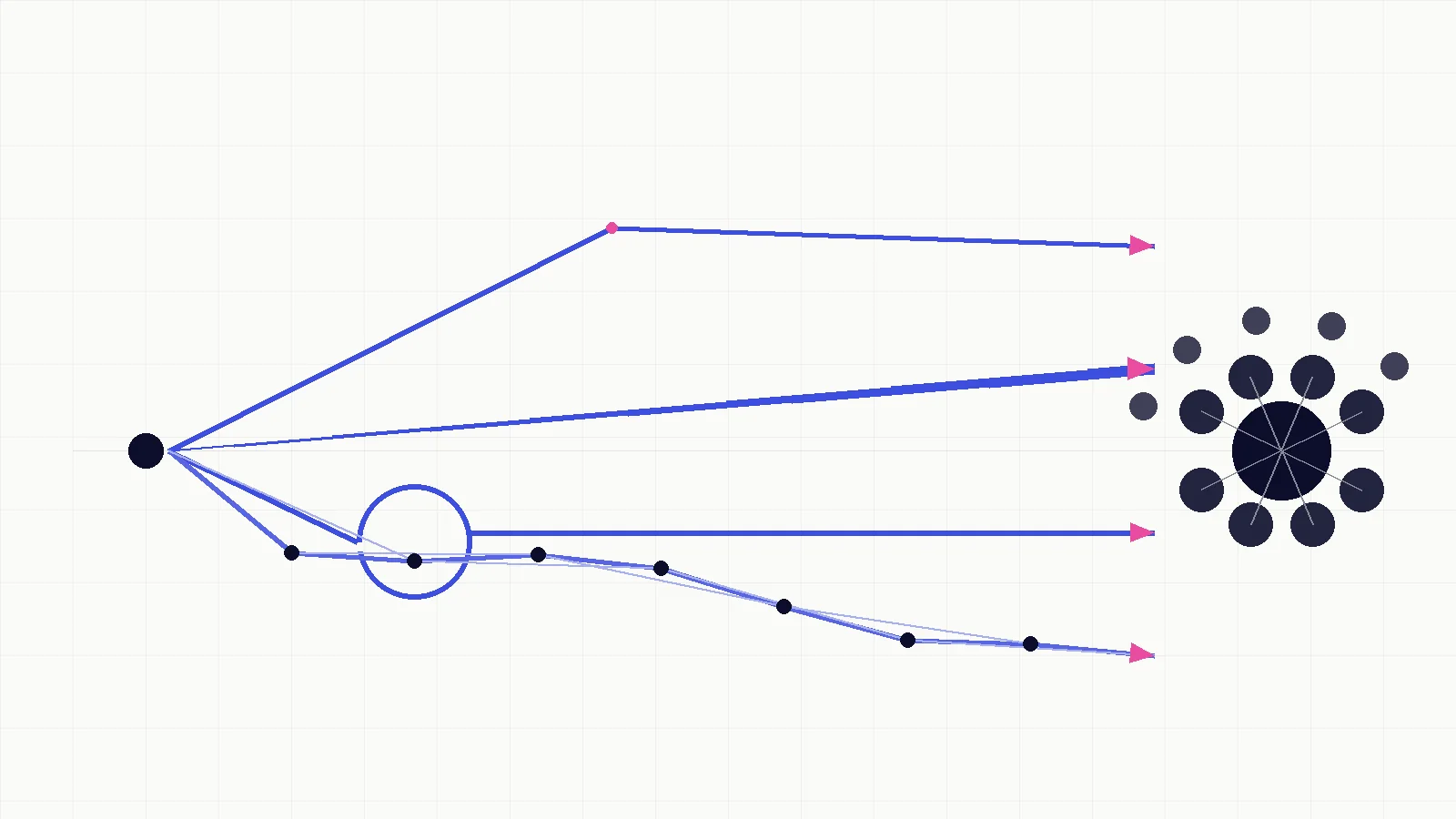
“When will we reach AGI — human-level general AI?” Debate about AI tends to converge on this single point. But Google DeepMind’s published report, “From AGI to ASI,” poses a longer-range question: perhaps AGI is not the destination, but merely a waypoint on a road that continues toward a superintelligence (ASI) that lies beyond it.
This report is not a record of demonstrated results; it is a document of forecasts and open questions, laying out what could happen next and what we should research (official source). That is exactly why it suits an executive forming medium-to-long-term assumptions better than any single technology headline. Below, without hype, we follow its throughline.
First, define AGI and ASI
Arguments usually talk past each other because the terms are left vague. The report makes them clear.
- AGI (artificial general intelligence): AI with capabilities on par with an average human across an extremely broad range of intellectual tasks. Not merely solving a given problem, but a stage possessing the autonomy to find problems on its own and move toward solving them.
- ASI (artificial superintelligence): a stage that, in every field, not only surpasses the most capable individual in humanity but also exceeds the collective intelligence of a large group of humans — output that thousands of experts could collectively produce over years — and keeps evolving autonomously across all domains.
The point is that ASI is defined not at the level of surpassing a single genius, but at the level of surpassing the collective enterprise of humanity. That is the line separating AGI from ASI.
Four routes from AGI to ASI
The report names four routes by which AGI could reach ASI. They are not exclusive; they may proceed in parallel, or in combination.
- Scaling: keep increasing models, data, and compute exponentially, as before. An extension of the past decade, and the only route we can forecast from track-record data.
- A fundamental shift in algorithms: the discovery of new mechanisms or learning paradigms, different from today’s large-scale pretraining plus fine-tuning.
- AI developing AI (recursive self-improvement): AI accelerates and automates the R&D of AI, and better AI speeds development further — a self-accelerating loop.
- A swarm of AIs becoming superintelligent: even if no single model is outstanding, many AIs swarming and coordinating as an organization produce results that surpass humanity’s largest organizations.
The fourth is already showing signs at our own feet. A way of working in which one person distributes tasks to several AI agents and runs them in parallel is fast becoming reality.
Even so, progress is not guaranteed — friction and bottlenecks
What makes the report honest is how carefully it lists the frictions, the bottlenecks, that accompany these routes. Scaling can hit economic and resource ceilings. The data available for training is running dry. Today’s paradigm may have a ceiling. Recursive improvement can stall midway, and a swarm’s coordination cost balloons as it grows.
Whether these frictions are negligible or walls that halt progress — no one knows yet. That is why the report leaves much as open research questions rather than as assertions.
The stance of “prepare because you cannot predict”
The future cannot be predicted. That holds for the pace of AI progress and for its impact on society. Rather than wait passively, the report argues, we should prepare on the premise that we cannot rule out progress that is both rapid and far-reaching.
And what it suggests is an image in which AGI’s arrival is not a single step that changes society once, but perhaps a continuous series of waves of transformation, occurring one after another across the fields of science and technology. The report concludes: to prepare, as all of humanity, for the future that AGI and ASI invite will take a grand undertaking — one that draws the world’s attention, unfolds at planetary scale, and crosses the boundaries of every field.
What executives should take from this
It may sound like a distant future. Yet the direction the report describes carries implications that bear directly on management today.
A shift from “wait for the single strongest AI to arrive” toward “first put in place a mechanism where several AIs collaborate, accumulate experience, and stay grounded in the work.” Among the report’s four routes, recursive improvement and swarm intelligence — and the digital-native advantage of being able to save, share, and reuse AI’s experience — all point to the same thing: how you use AI as an organization matters more than the cleverness of any single unit.
Nihonbashi AI Lab supports bringing this shift down to the front line of the work.
- Business design: sorting out which work to start AI use and automation from
- Data structure and access design: what to keep and who can reference it, built so it can change later
- AI use design: building judgment, procedures, and customer handling into a form AI can reference and coordinate around
- Operations: settling an operating cycle that keeps improving while in use
In our own daily practice of AI-driven development, we have several AIs collaborate and accumulate that experience as the organization’s memory, testing this direction in practice.
In closing
AGI may be not the goal but a waypoint. Whether ASI comes, and when, no one can yet declare. That is precisely why — neither over-hyping it nor ignoring it — we move forward, feet on the ground, with preparation that will not panic when it arrives. We will think through that first step together, starting from your own operations.
Let’s talk about how AI could fit your own operations
Contact usSources
- Official sourceFrom AGI to ASIGoogle DeepMind · Published 2026.06.10 · Fetched 2026.06.28