
Why your AI's knowledge never compounds
Plenty of companies want to hand their own knowledge to AI. But even companies with advanced setups — letting AI write into an Obsidian vault and search it with RAG — report that it never seems to grow. The people furthest ahead hit the wall first. The dividing line is whether the system stores information or consolidates it. If you are about to give AI your knowledge, here is the trap to know about before you start.

"Give AI our company's knowledge and let it grow like an employee." Plenty of companies want this. Far fewer have actually started.
The ones who have are doing something fairly involved. AI writes notes into a note app like Obsidian, and another AI reads them back to answer questions — the knowledge base people once maintained by hand is now written by AI and read by AI. An "AI second brain," if you like.
And yet the people doing all this say the same thing: the knowledge piles up, but it never feels like it is getting smarter with use. They have put in the effort, and still it does not grow. If the most advanced users hit this wall, it is worth understanding before you start. The reason is simple — most of these setups store information without ever consolidating it.
Before we get to why that matters, it helps to be clear about what "giving AI memory" actually involves.
AI does not really remember
Many people assume AI remembers everything. The opposite is closer to the truth. At any one moment, an AI can only read what fits in its context window — think of it as the size of its desk. Anything that falls off the desk, whether a long conversation, a separate chat, or yesterday's exchange, is gone by default. On its own, an AI starts almost from a blank page every time.
So to put your company's knowledge to work, you have to supply it from outside. There are broadly two ways. One is to keep your documents on a nearby shelf and, for each question, fetch the relevant passages and set them on the desk. This is RAG, or retrieval: the AI is not remembering, it is consulting outside material on the spot.
The other is to accumulate the exchanges and decisions themselves and carry them forward — agent memory, an AI's long-term memory. The two are not rivals; you can layer them. That is the basic idea behind giving AI memory.
And yet, as with the early adopters above, supplying knowledge from outside still does not make it grow. Most setups store, but never consolidate.
Storing and consolidating are not the same thing
Piling up information so you can search it later is a warehouse. Search is fast, but the contents only grow in volume; no new understanding comes out of them. The RAG we just described fetches relevant items from this warehouse and brings them over. Useful — but the warehouse itself gets no wiser.
Consolidating is different. Each time something is written, you draw out the key points and tie them together, reconcile duplicates and contradictions, replace facts that have gone stale, and let go of what is no longer needed. With consolidation in place, the contents get tidier the more they are used, higher-order lessons surface, and the whole thing grows. So the line between a warehouse and a memory is not retrieval — it is whether you consolidate on the way in.
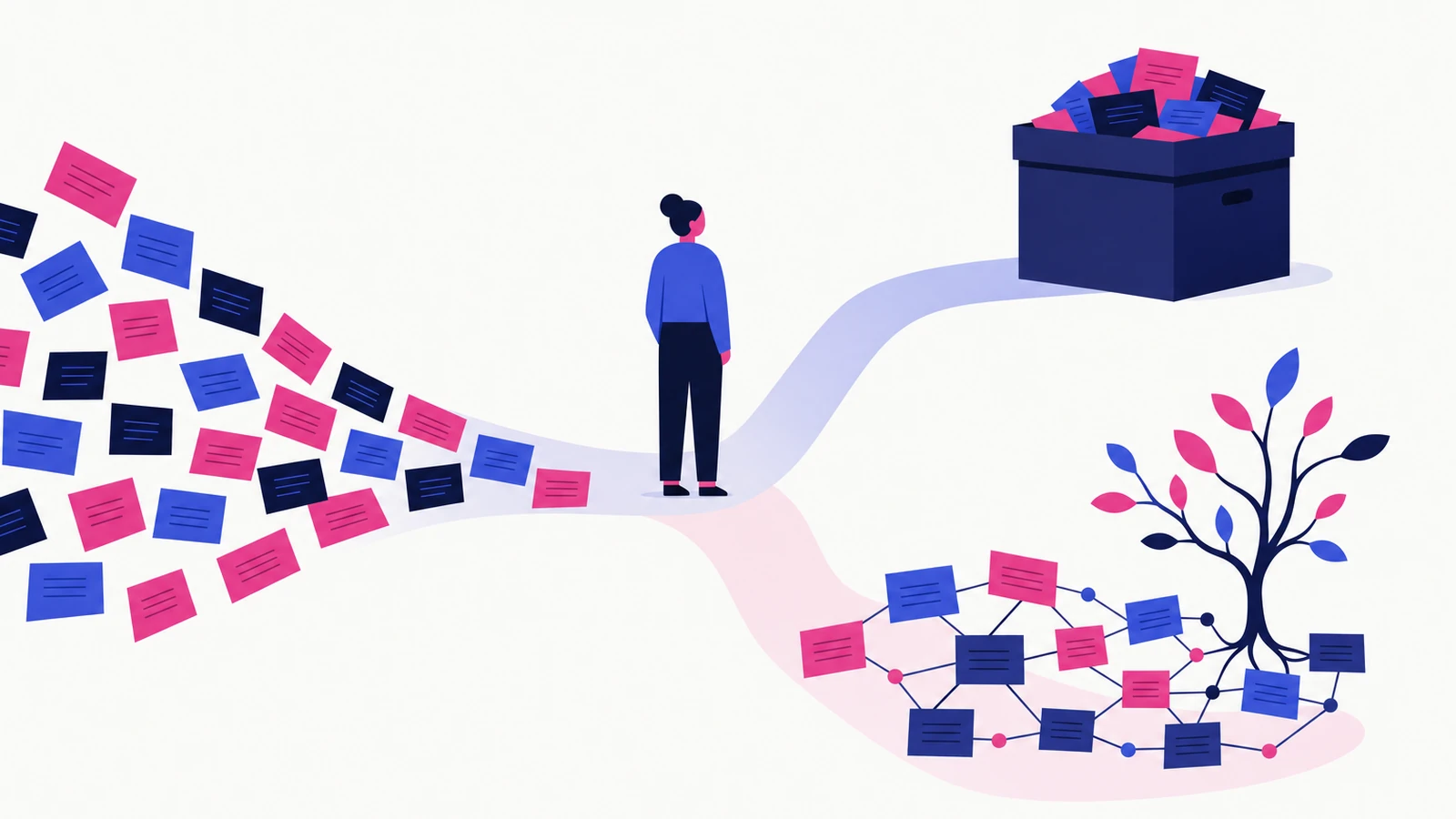
A clear failure case: you migrate your database to MySQL, and the AI keeps telling everyone you are on Postgres. Usually this is not a retrieval-accuracy problem. Without consolidation to overwrite the old fact with the new one, no amount of better search will stop the stale answer from resurfacing. A warehouse keeps the old box on the shelf forever.
Even when AI does the writing, without consolidation it is still a warehouse
Back to Obsidian. In 2026, the one writing the notes is not necessarily a person. Letting AI write into a vault and read it back has become an increasingly common way of working — the "LLM wiki" workflow that the researcher Andrej Karpathy laid out in spring 2026 is a leading example. It is not a product or an official standard, but a way of working.
But handing the writing from a person to an AI does not, by itself, make it memory. Whether the format is Markdown or the author is an AI, without a mechanism that consolidates, it is just "a warehouse an AI wrote." Add consolidation to a warehouse and it becomes memory. What separates memory from a warehouse is not the file format, and not whether a human or an AI does the writing. It is whether it consolidates on the way in. (Strictly, there are other axes too — how stale facts are handled, whose memory it is — but this is the one to check first.)
Even memory that consolidates is not a cure-all
To be fair, "memory that consolidates" is no cure-all. Some of what is marketed as "memory" is really just search over stored chat history — a criticism raised by vendors and researchers alike. Consolidation has its own hard parts: summarize carelessly and you lose the details that matter, and deciding what to forget is not easy.
That is exactly why, as an executive, the thing to watch is not the product name. It comes down to one question: does this thing consolidate every time it writes?
The one question for executives
Leave the technical details to your team. What management should own is the design decision one step upstream.
- Which information lives where, and who can access it — data structure and access design.
- Whether the AI's judgments, failures, and corrections are kept in a form you can reuse — the operating loop.
Get these two right, and when a newer model arrives you simply swap it in. Get them wrong, and every time you bring in a smarter AI you begin again from zero.
How we do this ourselves
This is exactly how we run our own development. Consolidation itself is handled by an agent-memory system (Hindsight); the interface where a person reviews it and makes the call is a dashboard we built for that. The machine consolidates the experience; a person reviews and searches it to decide. Keeping warehouse and memory — and the roles of AI and human — from blurring together is what lets the whole thing grow.
For the record, treating consolidation as the crux of memory is a framing that Vectorize, which publishes the open-source Hindsight, argues strongly for. There are other dimensions to what counts as memory, and this one reflects a vendor's view.
If you would like your company's knowledge to do more than pile up — to actually grow — the place to start is taking stock, together, of where things stand. You can reach us through our contact page.
Let’s talk about how AI could fit your own operations
Contact usSources
- Official sourceLLM wiki — a markdown knowledge base an LLM writes and maintainsAndrej Karpathy (GitHub Gist) · Fetched 2026.07.14
- Official sourceThe Consolidation Problem in Agent MemoryVectorize / Hindsight · Fetched 2026.07.14
- Official sourceAgent Memory vs RAGVectorize · Fetched 2026.07.14
- Official sourceGenerative Agents: Interactive Simulacra of Human Behavior (an early work that popularized reflection)Stanford / arXiv · Published 2023.04.07 · Fetched 2026.07.14
- Official sourceOpen Knowledge Format (OKF v0.1) — a markdown + YAML spec for agent knowledgeGoogle Cloud · Published 2026.06.12 · Fetched 2026.07.14
- Secondary coverageStop Calling It Memory (the "a vault is not memory" critique)limitededitionjonathan (Substack) · Fetched 2026.07.14
This article takes reported primary sources as an entry point and organizes industry trends alongside the perspective of Nihonbashi AI Lab. For the details of specific cases mentioned in reporting, please refer to the original sources.